
Why Bacteriostatic Water Contains 0.9% Benzyl Alcohol: The Preservative Science
Why bacteriostatic water contains 0.9% benzyl alcohol: membrane mechanism, spectrum, oxidation, and peptide compatibility. Research use only.
GLP-3 RT and Cagrilintide: Amylin and Incretin Co-Agonism in Research
How cagrilintide’s calcitonin-family receptors and GLP-3 RT’s triple incretin agonism are studied together in rodent and in-vitro models. Research use only.
AOD-9604 vs Tesamorelin: Two Approaches in Lipolysis Research
AOD-9604 is studied at the fat cell; Tesamorelin at the pituitary. How the two lipolysis approaches differ in design. Research use only.
Peptide Purity: What 98% vs 99% Actually Means on a COA
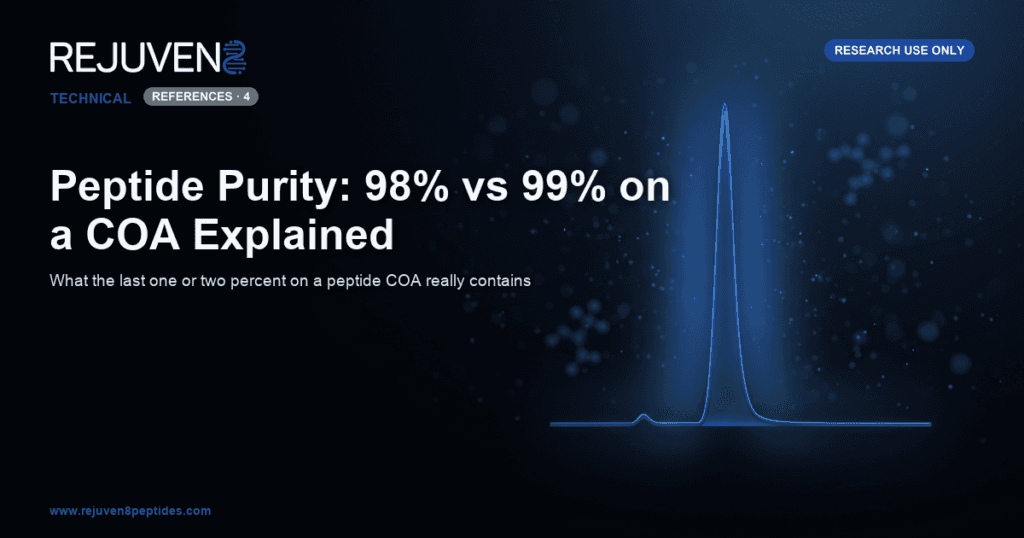
How HPLC area-percent purity is measured, what separates 98% from 99%, and how it differs from identity and net peptide content. Research use only.
Bacteriostatic Water for Injection, USP: What the Designation Means
What Bacteriostatic Water for Injection, USP means: the monograph tests, the Water for Injection grade, and 0.9% benzyl alcohol. Research use only.
Oxytocin in Social-Behavior Research Models: OXTR Signaling and Study Design
How the oxytocin peptide and OXTR are studied in social-behavior models, plus the design choices that make an experiment interpretable. Research use only.
GLP-2 Peptide Research: Dual GIP/GLP-1 Receptor Agonism Explained
GLP-2 TZ is a 39-amino acid dual agonist at GIPR and GLP-1R, not the native GLP-2 hormone. Receptors, engineering, and assays. Research use only.
BPC-157 and the Gut-Brain Axis: Preclinical Research
BPC 157 in gut-brain axis research: dopamine, serotonin, gut-barrier cytoprotection, and vascular signaling in animal models. Research use only.
5-Amino-1MQ vs Metabolic Peptides: Small Molecule and Peptide Research Approaches Compared
5-Amino-1MQ inhibits the intracellular enzyme NNMT while metabolic peptides act on surface receptors. How the approaches differ. Research use only.
How Long Does Bacteriostatic Water Last? Shelf Life, Expiration, and Storage
Bacteriostatic water has a sealed expiration date and a 28-day window after first puncture. Storage, oxidation, and stability explained. Research use only.