GLP-3 RT is a lyophilized, ≥99% pure synthetic research peptide supplied for laboratory metabolic and incretin-pathway research. Every batch is third-party HPLC and mass-spectrometry tested with a batch-specific Certificate of Analysis. For Research Use Only — not for human or veterinary use.
$34.99 – $129.99Price range: $34.99 through $129.99
2 Vials
5% Off
3 Vials
8% Off
5 Vials
12% Off
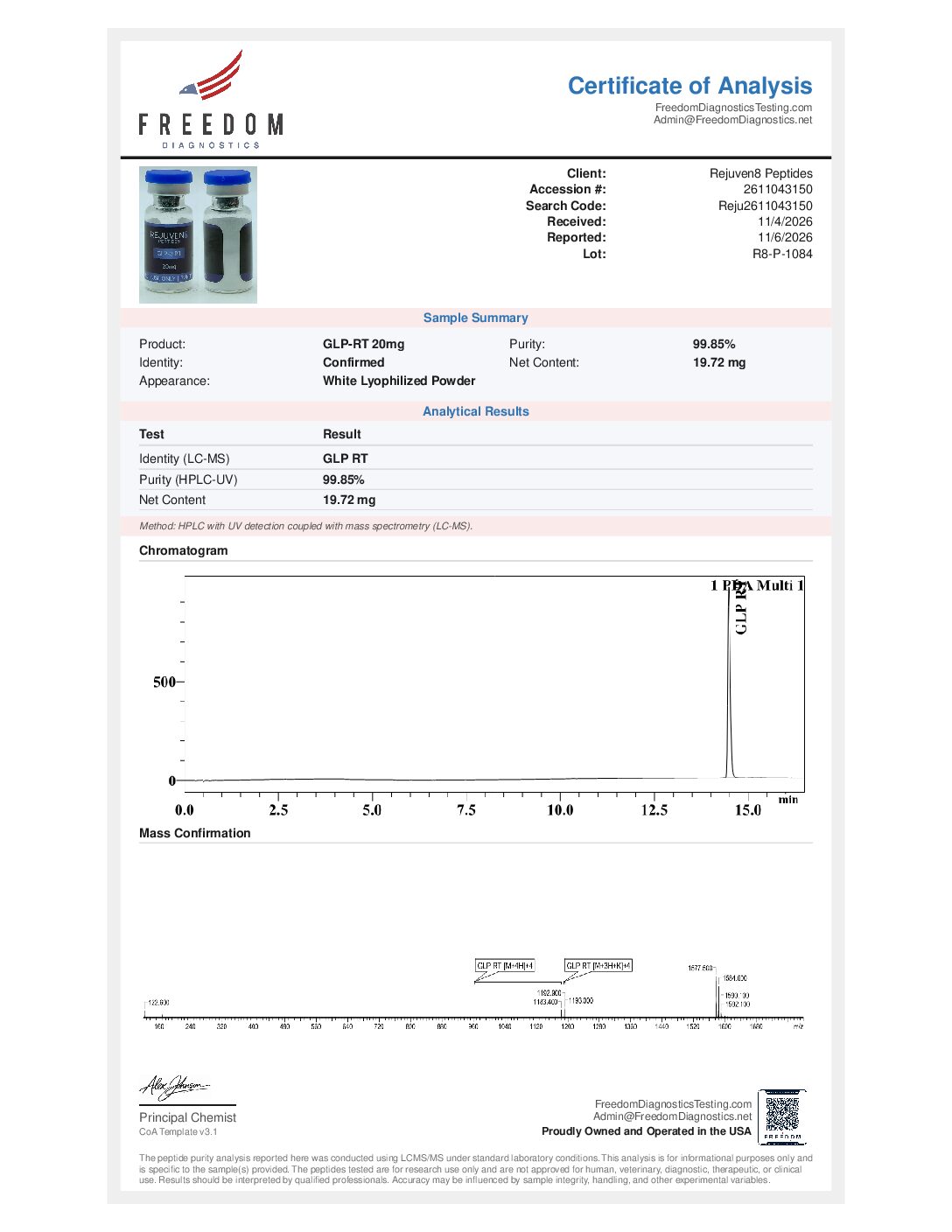
Verified purity data and more—third party tested by Freedom Diagnostics.
RESULT
RESULT
RESULT
RESULT
RESULT
RESULT
7x tested
GLP-3 RT is a synthetic research peptide engineered to engage three incretin-family receptors — GLP-1, GIP and glucagon — from a single molecule. It is supplied in lyophilized form, ≥99% analytical purity, for in-vitro and laboratory research into metabolic signaling.
Within the Rejuven8 designation system the numeral says how many receptor targets a compound engages: GLP-1 SM acts at a single incretin receptor, GLP-2 TZ at two, and GLP-3 RT at three. The “RT” suffix identifies the specific triple-receptor research compound in the series.
You will see the name written several ways — GLP3 RT, GLP-3RT, GLP 3 RT, or simply GLP-3 — in search queries, forum threads and supplier listings. They all refer to the same compound. On this page and on our Certificates of Analysis it is GLP-3 RT.
GLP-3 RT is studied as a reference material for how simultaneous activity at the GLP-1, GIP and glucagon receptors behaves compared with single- and dual-receptor agonists. It is supplied strictly for laboratory research.
Every batch of GLP-3 RT supplied by Rejuven8 undergoes batch-specific analytical verification to confirm identity, purity and net peptide content before it is listed.
✓ ≥99% Analytical Purity
✓ Third-Party Analytical Testing
✓ HPLC Verification
✓ Mass Spectrometry Identity Confirmation
✓ Net Peptide Content Verification
✓ Batch-Specific Certificate of Analysis
Each vial carries its batch number; the matching report is in our Certificates of Analysis library.
Researchers investigate GLP-3 RT to understand what a third receptor — the glucagon receptor — contributes to metabolic signaling beyond GLP-1 and GIP receptor activation. Areas commonly explored in experimental models include:
• triple GLP-1 / GIP / glucagon receptor signaling pathways
• glucose-dependent insulinotropic mechanisms
• hepatic glucagon receptor signaling and substrate utilization
• energy balance and nutrient partitioning models
• receptor trafficking, desensitization and signaling bias
• comparative studies against single- and dual-agonist reference compounds
These studies focus on how engineered multi-receptor analogs influence biological pathways involved in metabolic regulation.
GLP-3 RT is characterised in the literature as an imbalanced triple agonist: the three receptors are not engaged with equal potency, and that asymmetry is itself a subject of study. Reported characteristics include:
• measurable activity at the GLP-1, GIP and glucagon receptors from one sequence
• potency at each receptor that differs from the corresponding native ligand
• signaling biased toward cAMP accumulation
• DPP-4 resistance conferred by non-natural residue substitution near the N-terminus
• extended half-life in preclinical models via a fatty-diacid conjugate that binds albumin
Compound Name: GLP-3 RT
Peptide Class: Triple Incretin / Glucagon Receptor Agonist (GLP-1 / GIP / GCG)
Structure: Synthetic linear peptide, C-terminally amidated
Modifications: Non-natural residue substitutions; fatty-diacid conjugate via linker
Purity: ≥99%
Testing Methods: HPLC & Mass Spectrometry
Net Peptide Content: Verified
Appearance: Lyophilized white peptide powder
Vial sizes: several masses available — select above; each vial is a single lyophilized fill
Each batch undergoes analytical verification to confirm peptide identity, purity and net peptide content.
Store lyophilized vials in a cool, dry environment away from direct light: refrigerated (2 to 8 °C) for short-term storage, −20 °C for long-term. Keep sealed and desiccated until use. Reconstituted solutions have their own stability window and should be handled per your laboratory’s protocol.
Same compound. “GLP-3 RT” is the designation we use on the label and the Certificate of Analysis; the other spellings are how people type it. If a listing elsewhere drops the “RT”, check the sequence and the COA rather than the name.
By receptor count. GLP-1 SM engages the GLP-1 receptor; GLP-2 TZ engages GLP-1 and GIP; GLP-3 RT engages GLP-1, GIP and the glucagon receptor. Researchers comparing single, dual and triple agonism in the same assay typically run all three. Our GLP-3 RT receptor signaling overview goes into the pharmacology.
HPLC purity, mass-spectrometry identity confirmation and net peptide content for the specific batch, from an independent laboratory. Match the batch number on your vial to the report in the COA library.
Sealed, dry, away from light; refrigerated short-term, frozen at −20 °C long-term. Avoid repeated freeze–thaw of reconstituted material; aliquot if your protocol requires multiple draws.
Lyophilized peptides are brought into solution with a laboratory-grade solvent chosen for the application. For multi-session research workflows that is usually bacteriostatic water; preservative-free sterile water is used where a protocol requires it. We do not provide usage or dosing guidance.
Several lyophilized masses — select the size above. Every size is tested the same way and carries its own batch COA.
No. GLP-3 RT is supplied strictly for laboratory research. It is not for human consumption, therapeutic or veterinary use, and not for any form of self-administration.
This compound is supplied strictly for laboratory research purposes only. Not intended for human consumption, therapeutic use, or veterinary use.
Explore additional research peptides that may complement your current areas of study.